-
Trip to Rothko, Hopper, and Scheeler
A few months ago, inspired by Dar Williams and Jacob Geller, I stopped by the National Gallery of Art, specifically to check out Mark Rothko and Barnett Newman's paintings on display, before continuing on my way to a concert nearby.
The depth of Rothko and Newman's work typically comes from the depth of their uniquely mixed colors. Cameras can't capture them, screens can't reproduce them. Artists and scientists put immense effort into recreating and restoring these subtleties when necessary. As such, I don't have any photos of my own to share from the trip. I've linked to the gallery's images, however if you get the chance and are interested you should see them in person. The museum itself is free and those working there are incredibly helpful at getting you to the portions you'd like to see, even in a time crunch.
My favorite of the gallery was Rothko's "Black Form Painting, No. 6" The difference between the outer and inner darknesses was striking. The linked photo doesn't do justice to how deep they both were.
I also enjoyed the abstract Personage Two, which while also not done justice by displays and cameras and such, I struggle a bit more to explain why, or why I liked it so much in person. It's a brilliant mess that reminds me a bit of Don Hertzfeldt's "World of Tomorrow" films.
Newman's "The Stations of the Cross" series had a consistent vanilla beige, whose scale and execution was impressive. The variations of each was subtle, and sort of progressed around the room. Each piece's dark and light vertical stripes more disorderly than the last.
Newman's consistency made Rothko's gallery feel all the more chaotic, like comparing Mozart to Grunge. I enjoyed both, but felt Rothko's pieces pull me in more that day. I'm not sure why, but think it was partially to do with each being standalone, rather than part of a set. Each of Newman's required the others surrounding it to appreciate the display in it's entirety, which I hadn't given myself the time to sit in and absorb.
The Hunt for Hopper
From the Rothko and Newman pair I went down stairs in search of Edward Hopper pieces, and stumbled across several great paintings along the way.
Starting with Key Sage's "A Finger on the Drum", which is a wonderful minimal composition of an abstract landscape. Followed by Max Ernst's "A Moment of Calm", whose scale and detailed shading can't be felt through it's picture online.
I had to stop for a second when I crossed by Jackson Pollock's "Number 1". I didn't know it by name but it is the most recognizable style of abstract art for a reason, and that's conveyed even more so in person. It doesn't make me feel much, but I see how some are captured by the chaos it pervades.
Finally, I made it to the only Edward Hopper piece I saw, "A Cape Cod Evening". Featuring a couple by their house, and a Collie front and center in a field. I'm not as familiar with Edward Hopper and was there looking for compositional inspiration. Much like the dog, I was more interested in the forest's blue-green depth and darkness than anything else in the painting.
Fortuitous Final Finds
I took a beat to appreciate two final paintings on my way out.
First: Edward Lopper's "Quarry". Wonderful swirly storm clouds with streaks of light peaking through, highlighting despair and destruction of a landscape, dead looking trees and brown grasses surrounding a quarry pool, and industry churning in the background. I bike by a quarry every so often and this captures what it feels like on devastating days.
And lastly, possibly my favorite from the day, Charles Sheeler's "Classic Landscape".
I took the train up the east coast about a month prior to this visit and spent a decent amount of the ride thinking about how dull the views from the train are. Industrial yards, manufacturing facilities, shipping containers, all repeating along the trip. That's what this piece reminded me of. Only then did I look closer and read the name. It's the only name that day to have a serious impact on my appreciation of the art. It really is the modern classic landscape, plumes of gray oozing into the hazy sky and all.
The composition, with the strong leading rails running off to the right, the light on each individual board fading off into the distance, is fantastic. The building itself reminds me a bit of NaissancE, looking almost ridiculous at it's scale, although it is a bit more clear about it's purpose of processing containers of material being shipped in. Maybe they're coming from Edward Lopper's Quarry.
I'm not surprised to learn of Sheeler's photography experiences, touring and documenting Ford's Model T factories. I love the industrial atmosphere running through the photos and paintings, the soulless nature of these factories being fully explored and exposed. Researching his other work online, MoMA's label of his "American Landscape", points out it's lack of people, and how that may be "reflecting an ambivalence about the country's shift toward the industrial". Through that the "Classic Landscape" I felt the factory's apathy, towards the people, and the environment that it has enveloped.
Another splendid source of inspiration for my own creative work, and successful trip to the gallery.
Published
-
Computing within Limits 2026
Several months ago I attended Computing Within Limits 2026. Well, it was online, so I joined a zoom call for the 3 days. It was as good a time, focused on the overlap of computers and sustainability.
Generally I lurk in the permacomputing regions of the web. This conference's workshop format: mixing discussions and presentations was good for pushing me to participate. It was very academic and I'm rarely one to sit and read research papers in my free time, let alone speak up in a discussion about them. This conference forced me through those nerves and I enjoyed it all the more because of it. As a bonus, everyone I talked with was wonderful, welcoming and enthusiastic.
Coming more from the software engineering industry side of these discussions I learned a lot about the sustainability & environmental impact side. Not just the direct impacts and work being done, but also the feelings of those working in those fields.
My Takeaways
Structural Change, Not Dashboards
Nobody wants dashboards and for good reason. There was a paper that culminated in a score that could be used by teams to measure ecological impact. I approached the post-paper discussion with a fairly positive outlook on it, but the experience of those I talked with there made it clear that these sorts of things can't be counted on.
A new dashboard itself doesn't change the structure of the business, or its fundamental goals, as such they don't limit the companies ecological impacts effectively. Given that most business structures (promotion paths, business strategies, performance metrics) promote and rely on growth, and these scores and dashboards encourage de-growth, the systems are at complete odds. Any dashboard introduced will likely mean nothing to the higher ups making decisions, so it will mean nothing to the workers and work being measured. Instead it looks like something's been done, so it can be a box checked by those in charge to say "we're doing sustainability", when they're not changing anything.
Apparently this is an incredibly common that pattern that I wasn't aware of. The metric being introduced in the presentation wasn't worthless, and could provide useful insights, but isn't a structural solution that will on it's own instigate change. I wish I had clocked that in the moment, but one of the joys of being wrong is that now I have a better understanding.
Everything Advertises Itself
I say this, knowing that I'm typing on a MacBook, listening in through a pair of AirPods. I also bike to the local coffee shops, and my 5 year old Android phone is still going strong.
Every car out in the lot, and the lot itself for this coffee shop and it's surrounding shopping mall is an advertisement saying that Driving Is The Way. My bike parked in the middle of it all is an ad for an alternative. Every metro trip to and from the grocery store is an advert for that option. Every year older that my devices get is a sign that a new whatever still doesn't matter.
I won't just stop using my unsustainable computers. I'll make them last like everything else I use. Living sustainably, even if only partly, is an ad for more sustainability. How you present yourself is important, as it can plant ideas for anyone who sees how they too can live.
Sustainable Systems are Inevitable
It's a broad takeaway but it's worth considering while other recent technological developments are claiming inevitability, this is one situation where that's actually a safe bet. For better and worse, unsustainable systems will pivot into a sustainable one, or will degrade and collapse. Irrationality can last a long time, but it will fall apart.
Can computers be built in a way that is fully sustainable? Can software be developed and deployed sustainably? I don't know. If the rest of society suffers some amount of collapse as a result of their wide use, then maybe not. Component production relies on the global supply chain. That supply chain becoming less consistent for any reason will inevitably affect computers among many other things.
An important note is that the impact of unsustainable systems are unevenly spread, so those causing ecological collapse in one area are unlikely to feel the effects. Sustainability may be inevitable, but the path there isn't going to be easy, and intentional ignorance from the systems beneficiaries is almost always a given.
Cool Work is Happening
It's easy to feel like nothing is happening but there are people trying to build sustainably.
People are recycling computers, building frameworks that run on older and lower end computers to make it easier to keep things running for longer. People are exploring alternative forms of environmental cooperation, thinking outside of the restrictions of existing limitations. There is work being done and there are reasons to be optimistic.
Further Reading Ahead
All of the papers seemed worth reading in depth. I haven't gotten to them. It's been months and I haven't. I'm going through with posting this now anyways. If the takeaways here caught your attention, I recommend checking the Computing within limits 2026 site to go through and read the papers that led to them.
Beyond papers, several books were mentioned throughout that I plan on checking out (eventually) as well.
The Collapse of Complex Societies
- This seems to be a fundamental bit of reading in the sustainable computing space, so much so that it was mentioned off hand as though all attendees have read it.
Understanding Planetary Limits
- Edited by: Chelsea Schelly, Bonnie Nardi, Robert McLachlan, and Ben McCall. A book by some of the presenters, which isn't out yet, but I'm keeping an eye out for it.
Energy at the End of the World: An Orkney Islands Saga
- Not directly mentioned during the presentation, but the Orkney cloud was mentioned, and I went down a slight rabbit hole to look into it. As a result this book has ended up on the list.
Governing the Commons
- Elinor Ostrom's Eight Principles were mentioned a few times, but I was entirely unfamiliar with them. This hopefully will be a good introduction to Ostrom's research, as well as provide more background on those principles that seem to come up frequently. Additionally, I'll check out Derek Wall's "Elinor Ostrom’s Rules for Radicals" to go further down this rabbit hole.
Why Now
This is being put up way later than I intended. As a result I'm sure I've forgotten important details, and I know that there's a lot from the discussions that didn't make it into my notes. I had hoped to dive deeper into the papers but the last few months haven't allowed for it, and the next few seem like they wont either. Despite that, this post and the event have lingered in the back of my mind, feeling too important to drop.
So, I'm putting this up now because it's better late than nothing. I can least share a bit of what I took away from my experience. This conference's attendees and presentations were a light in the darkness. I hope to attend again in the future, more informed and with more to contribute and take away from it.
Published
-
2026 iPhone Event Impressions
I ramble a bit at the start about where I'm at when it comes to my phone usage. Feel free to skip to the second section for my thoughts on the new phones and such.
Pre Ramble
I'm going into Apple's 2026 iPhone event having had the first feeling that my Galaxy S20's battery isn't lasting quite long enough.
Nothing I do phone-wise is particularly strenuous, given that I track workouts via my watch, metro or bike where I need, and don't even text much on my phone if I can help it1. Nearly none of my computing is done on phone. It instead acts as alarm, alerts, audio player, and otherwise digital swiss-army knife.
But, I've had a busy few months full of long travel days2 with uneven access to an outlet, nor time to sit and recover some charge from the laptop. Long drives with spotty service, searching for and connecting to cell towers for a few seconds before starting again. I have had a few days where the phone was barely scraping by and one day of admittedly mild travel misfortune3 it was dead well before the day was done, making coordinating plans a challenge.
I'm expecting to need a new phone in the next year or maybe two, pending further device decay and limits to spare parts4.
An iPhone is Unlikely
At the moment I don't anticipate my next phone being an iPhone.
I've got a few use cases where easy access to the file system is necessary5, as well as preference for some options exclusive to android, primarily the thumb print sensor, as well as off brand apps for things like YouTube6. I don't expect Apple to add these features, nor do I see anything coming out that truly draws me in.
The industry tends to copy what Apple does, but the industry has changed a bit since my Galaxy S20 purchase. New variable phone shapes have been tried by many of the major brands. Apple has a history of being slower to adopt gimmicky features, but 5 years is a long time to go without trying something. It is now them playing a catch up, which is kinda fascinating. Will they come in with the obviously better software and hardware design decisions? Or will they be releasing a flop far too late into a mature category of folding device?
I've written this preamble (pre-ramble?) prior to the event, to give us both a sense of where I'm coming from in the world of mobile computing devices. Apple has smart engineers who have worked hard on this new device and the software that runs on it, not to mention their other devices. Their production team do wonders to make the kinda gross, inherently political, situation that is the modern tech industry in which they operate seem distant. At the very least it's an enjoyable bubble, even if it usually bursts when it meets reality.
Today's Event
We open with not an ad for Apple TV, but a build up to "Hello" , which just doesn't hit the same as "Good Morning".
The Pro
Beginning with the new Pro, the only interesting feature is the variable aperture. Very cool and opens up a lot of custom control and artistic decisions that I don't think is available in any other phone camera system. I'm still fairly new to photography but I know that this is a part of the exposure triangle for a reason.
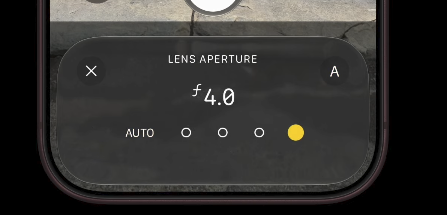
Screen shot of a portion of the camera controls from the iPhone, showing 4 options but only specifying f4.0 at the furthest to the right.
It does seem like there's only a few aperture settings, but more options in the camera that people always have on them is good. Peeping closely on the credits for the photos I spotted f1.48, f1.8, f2.8 f4.0.
I am curious about Apple Reference Image tracking being baked into iPhone photos. It seems like for better or worse, it could be used to track a photo back to the iPhone, and it's user, that took it. Printers come with built in tracking dots, and life has continued on as expected.
There's also a note about it not being available in the EU and China. I suppose that's something to do with how you authenticate these photos their cloud service. They compare it to a digital negative of the shot, but in that case only you have the negative. This relies on a trusted third party to have signed off on it, and presumably be able to verify it later as well. I'm no expert in this area, and look forward to learning a bit more as real experts look into it.
AirPods & Watch
Nothing much to say about either. This was basically coffee break time. I'll probably have more to say about my used set of AirPods, and their issues and oddities being paired with an old version of Mac OS and Android.
For the watch, didn't see any features that I really felt like I needed. The battery life of mine seems better than the Ultra, but again I use it for fairly basic running, biking, and morning alarms. That's about it.
I would like to better understand how "Siri Recap" works, my main concern is it's the lack of consent in always building a recap of the audio around you. Ambient processing of audio is already happening on Google's pixel, for detecting music playing, so I can't say this is pushing that boundary. Live transcribe too, seems to lack this consent, and both features encourage anti-social talk to the tech, not the person in front of you behavior. It might be slightly better than nothing for accessibility, but the demo with the waiter still felt off.
I do like that they set the AirPods in a train station. With 50% more effective ANC, Air Pods 5 will let you walk in front of a train so much better. It's OK though, your new watch can still call an ambulance for you.7
iPhone Duo
As mentioned in the preamble, there are a few key preferences I have in my search for a new phone. Things they could bring back that could get me interested again, and they actually did it with one!
They brought back the finger print sensor. It seems like they're using the same style sensor system as used in the iPad mini. I do wonder if they'll keep making that tablet, given that ignoring the price the Duo checks almost all of the Mini's boxes. The Duo's screen is slightly smaller, so maybe that will be enough to differentiate it?
Closed, the Duo has a 5.4" screen. This is the same size screen as the best iPhone ever made the 12 and 13 mini8. I hadn't considered that it would be smaller closed than the standard iPhones. Given the width it probably won't feel too much smaller, but it'll be smaller. Looking closer at the screen sizes of the Galaxy Z Fold8, I shouldn't be surprised by this. But the thought of using one of these, always closed as a mini phone is too fun.
There's a few small things, like the inner screen blurring on the one side when the phone angle is being adjusted. The main controls pushed to the right feels obvious now that they've done it and reminds me of the Samsung's Note Edge, with it's one curved edge and controls. I bet that will be copied as default on the other passport style phones going forward. I do wonder why the pen support is "coming soon". Does it support charging the Pen? Maybe an external wireless charger is coming for it.
The real trick that I think will make this device stand out atop the rest of the folding phones is the matching opened and closed aspect ratio. It is kinda genius and probably makes designing apps for it quite a bit easier than for any other folding phones. It's similar to A4 paper, (well, all A-series paper), everything can scale to all of the other sizes. There's only one new size that has to be built for, the rest is technically optional9.
Theoretically you could get one of these intending to never open it and use it as a mini phone. At it's full $2000 starting price that would be ludicrous, but if/when the inner screens start going bad and this phone pops up on the used market, it could be a fun option. They could have made half of this phone and ended up with the basically best phone for me. But, they made this instead, and that's alright.
Conclusion
I'm not getting any of these any time soon. Perhaps someday refurbished, used, or through some serious discount if I can find it. None of it is too exciting to me, otherwise I'd already have a folding device.
But for a lot of people, this is their first time considering a folding phone as possible at all. On today's run with a friend in a non-tech field, I learned that their coworkers were watching the event and excited about the Duo (or, at least thought it was cool). They may have reset the tone around folding phones. I'm a bit curious how that will translate to sales, and the real world adoption of them.
The presentation did have a lot of discussion and demonstration of features that I have an active disinterest in. I've left out any thoughts on those features, other than where they are going to affect the people around them.
There were a couple neat features I'd like other phone manufacturers to steal though:
- Variable Aperture in the next year's android phones would be cool. Manual control of them seems like a must for that feature, which could open up more manual options in the camera systems as well.
- Power Button Fingerprint Sensors should make a return Under screen ones are fine but feel finicky. Neither beats the ideal location from the Nexus 6P: on the back, where your fingers already rest.
- Mini Phones! Technically it's got a small display. Samsung's flip is probably as close as I'm going to get to that dream, and their Fold8 is near enough the duos to work for me to consider it as "mini". I don't personally want anything that folds though, so the existing small options are basically all out.
- Under Screen Front Facing Camera would be interesting on Apple's other phones. I suppose it must be a serious downgrade in quality in camera or possibly that portion of the screen for them to justify the top cutout still everywhere else. That seems to be the case with the android phones that have gone that route.
Not a feature of the phones, but I appreciate that every photograph featured in the presentation cited who shot it, as well as the specs. Until recently I've been content with my phone so haven't been following the announcements too closely. As such, I'm not sure if other companies do this. If they weren't I hope they begin to do so going forward, just so I can be a nerd about the specs and appreciate the photographers work. Pictures don't take themselves.
There should probably be a credits roll at the end of this production too, given the obvious scale they're operating at now. I know they like to advertise that this whole thing was shot "on iPhone" but it was shot by people who are obviously very skilled at what they do. The thank you at the end was something but they deserve some more credit.
Apple and the rest of the manufacturers have all of the bits to make the perfect phone hardware wise, and software is fairly malleable, so I could probably get things working close enough to how I prefer regardless of what I go with. Maybe over the next year someone will actually do it.
1Usually a run or bike ride is on routes which are well known enough to find my way without any maps or, not far enough to get too turned around. Occasionally I'll use the phone's gps to find my way to a specific spot on the bike, and a long day of that seems to drain any battery still. Texting via a linked laptop is way more comfortable for me than typing on a phone.
2Fortunately all for fun reasons, Bachelor party's and the like, with similarly travel necessary weddings coming up as well.
3The plane had a false start and couldn't get it's wheels up after circling for half an hour. Luckily It returned back to our initial airport without issue. Much better than landing without the wheels down though, so I won't complain any more about it.
4See the log of repairs and thoughts. I've replaced the back glass twice and power button once in the course of owning it, and will heavily consider replacing the battery if that is deemed the only issue. The back glass seems to be no longer available, but iFixit still has batteries, and there's always eBay for spare parts.
5Obsidian sync through Syncthing, with the phone as the central hub for laptop and desktop since it is the most likely to be online and connected to a network. I know there is the paid sync service, and I assume there are ways to use Syncthing on iOS. This is an example of one of the few, more technical edges of my mobile usage that doesn't have an immediate parallel I know of to jump to.
6In my case, for NewPipe in the rare event I'd like a YouTube video on my phone. It works slightly better as a video player than in FireFox, but is still discouraging enough to keep me watching too much.
7I jest, they're both improvements to the things. I like my Airpods ANC, and would rather an automated ambulance call than none at all
8To be clear, I haven't used these. But if they had kept making them they'd be in the running for next phone for their size alone.
9A friend clocked this as like only having to build a website for desktop, and mobile comes free with it. Feels like a good parallel. Obviously they demonstrated features of some apps that take advantage of the changing screen size, but this is about the basic use cases being easy as well.
Published
-
Losing the Time War
Dear You,
Knowing almost exclusively the title, I dove in expecting an enjoyable but typical sci-fi romp, featuring a twisting tale of a futuristic war long in the past. I was delightfully mistaken. Instead, I was regaled with a collection of delicately crafted calling cards turned love letters documenting butterfly effect espionage evolving into a budding relationship.
The literal of the story felt best left to the side, with it's abstract atrocities. I still can't tell what each side was fighting for, as frequently seems the case with war.
Those details discarded, a focus on the flirtatious love story could take root, which through fanciful prose explores a depth that precision would not envelop. Such that I don't know how to further discuss it, but I know that I enjoyed it.
Sincerely,
Me
PS. I appreciate that the two care to a fault. About their craft, then each other. It was a joy to read a story where that played a pivotal role, and passion turned into passion.
PSS. I read this as an audio book, and think I would have struggled through a traditional read. This has convinced me to give poetry a listen in this format.
Title: This Is How You Lose The Time War
Author: Amal El-Mohtar & Max Gladstone
Read By: Cynthia Farrell & Emily Woo Zeller
ISBN: 9781534431003
Published
-
Dispossessed Digressions
Contrasting a world primarily struggling between socialism and capitalism with an anarchist society, The Dispossessed highlights success, absurdity, and failure in them all.
Unlike Walkaway's abundance, the desert world Anarres contains a scarcity bound lifestyle reliant on cooperation. At times survival seemed borderline impossible. The stabilizing production and social pressures, which evolved in those times of strife, are now stagnant and creating a regime of their own. In prosperity they fail those who push in any direction beyond the norms.
Meanwhile in the capitalist establishment, recognizable struggles occur. The rich live in extravagance, and the poor might as well not exist. Except they do, and they are left to suffer.
Systemic flaws of all kinds demand subversion, reform, or eventually revolution.
Initially disorienting, uncomfortable and explicit at times, unstable and thought provoking to the end, I'll be referencing and recognizing aspects of The Dispossessed for the unforeseeable future.
Author: Ursula K. LeGuin
Title: The Dispossessed
Read By: Don Leslie
ISBN: 006051275X
Published
Archive
-
📷
-
💼
-
📆
-
📆
-
📆
-
🗓️
-
🗓️
-
🗓️
-
🗓️